Your Software Has New Users
A broader workforce is starting to use enterprise software
 Not long from now, most businesses will run with two kinds of workers: humans and agents. Not AI assistants waiting to be prompted, but software entities carrying context, taking action, and completing work inside the same systems your employees use every day. A datacenter full of agents, working alongside your human workforce.
If you accept that as a reasonable near-term outcome, one implication stands out above the others: your software needs to be as usable by agents as it is by people.
Screen-based interfaces are still essential. But they were never designed for agents, and they are not enough on their own. In the same way that modern software had to become API-accessible to participate in a connected enterprise, the next generation of relevant software will need agent-friendly pathways too: APIs, CLIs, structured tool interfaces, and MCP-compatible surfaces, all paired with clear permissions and observable actions. The question is no longer only whether software works well for people. It is whether it works for the full workforce.
Agents are changing the shape of work
Most of the current conversation around AI still assumes a simple model: humans use AI tools to move faster. That is part of the story, but probably not the most important part. The more meaningful shift is that agents are becoming participants in the work itself. Not assistants waiting on prompts, but colleagues that carry context across steps, interact with systems, and contribute to outcomes alongside people. The workflow is no longer a person using a tool. It is human judgment and machine execution operating together, often within the same systems, toward the same goal.
If that becomes the normal operating model, the software underneath the business has to evolve with it.
Human-only software assumptions will not hold
Most enterprise software was built around a single assumption: the real user is a human in front of a screen. APIs became standard, but even then the design center stayed the same. The interface was for the human. The API fed another system whose interface was also for the human. The person was always driving.
That model holds up fine until agents enter the workflow as active participants. A system can have a polished UI and still be difficult for an agent to operate. It can expose APIs and still lack the structure, clarity, and control that reliable agent use requires. Software can be modern by every traditional measure and still be poorly suited for the next mode of work.
That is where this becomes practical. If work increasingly happens through a combination of human decision-making and agent execution, software that only works well for humans becomes a constraint. Not because it stopped functioning, but because it no longer fits how the work gets done.
Agent-ready software is a design requirement
This is why agent-readiness is becoming a real design requirement, not an interesting technical footnote.
An API alone does not make software agent-friendly. Agents need systems that expose capabilities in a structured way, communicate what actions are available, apply the right permissions, handle failure predictably, and make activity observable. Depending on the context, that might mean APIs, CLIs, structured tool interfaces, MCP-compatible surfaces, or machine-readable schemas. The specific mechanism matters less than the outcome: the system needs to be legible and operable beyond the screen.
Software now needs to do more than present information to people. It needs to expose usable work surfaces for agents too. The next generation of durable enterprise software will support both.
Existing software now faces a relevance test
This is not only a consideration for new products. It applies to everything already running in the business.
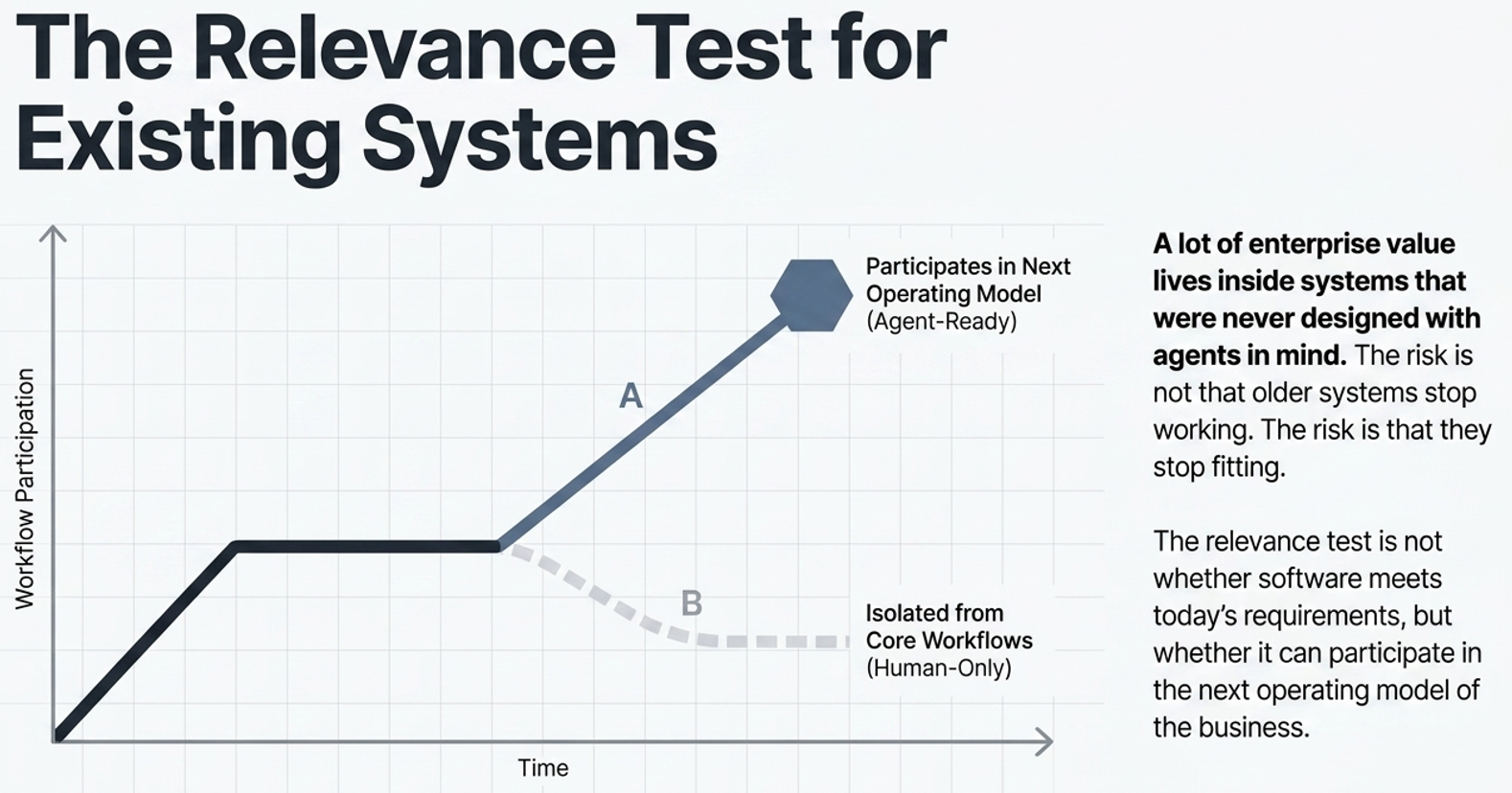
A lot of enterprise value lives inside systems that were never designed with agents in mind. Those systems do not become irrelevant overnight. But they risk becoming isolated from the workflows that matter most if they can only be operated by humans. That is the relevance test: not whether software meets today's requirements, but whether it can participate in the next operating model of the business.
The risk is not that older systems stop working. The risk is that they stop fitting.
Design for the full workforce
None of this means every application needs to become fully autonomous, and it does not mean every workflow should be handed to agents. The real requirement in most organizations will be more grounded than that. Agents will need bounded access, clear roles, explicit permissions, traceable actions, and defined points of human review.
That is the actual design challenge. Not maximum autonomy, but useful participation. Not removing people from the loop, but building systems where humans and agents can work together with the right structure and controls in place.
If businesses are moving toward a workforce that is part human and part agent, software strategy has to catch up to that reality. AI readiness is not just about models, copilots, or experimentation. It is also about whether the systems underneath the business are ready to support a broader group of users.
Your software has new users. The systems that matter most in the next phase of work will be the ones ready to support them.