AI Agent and Copilot Podcast: Why Software Design Needs to Place Agents on Par With Humans
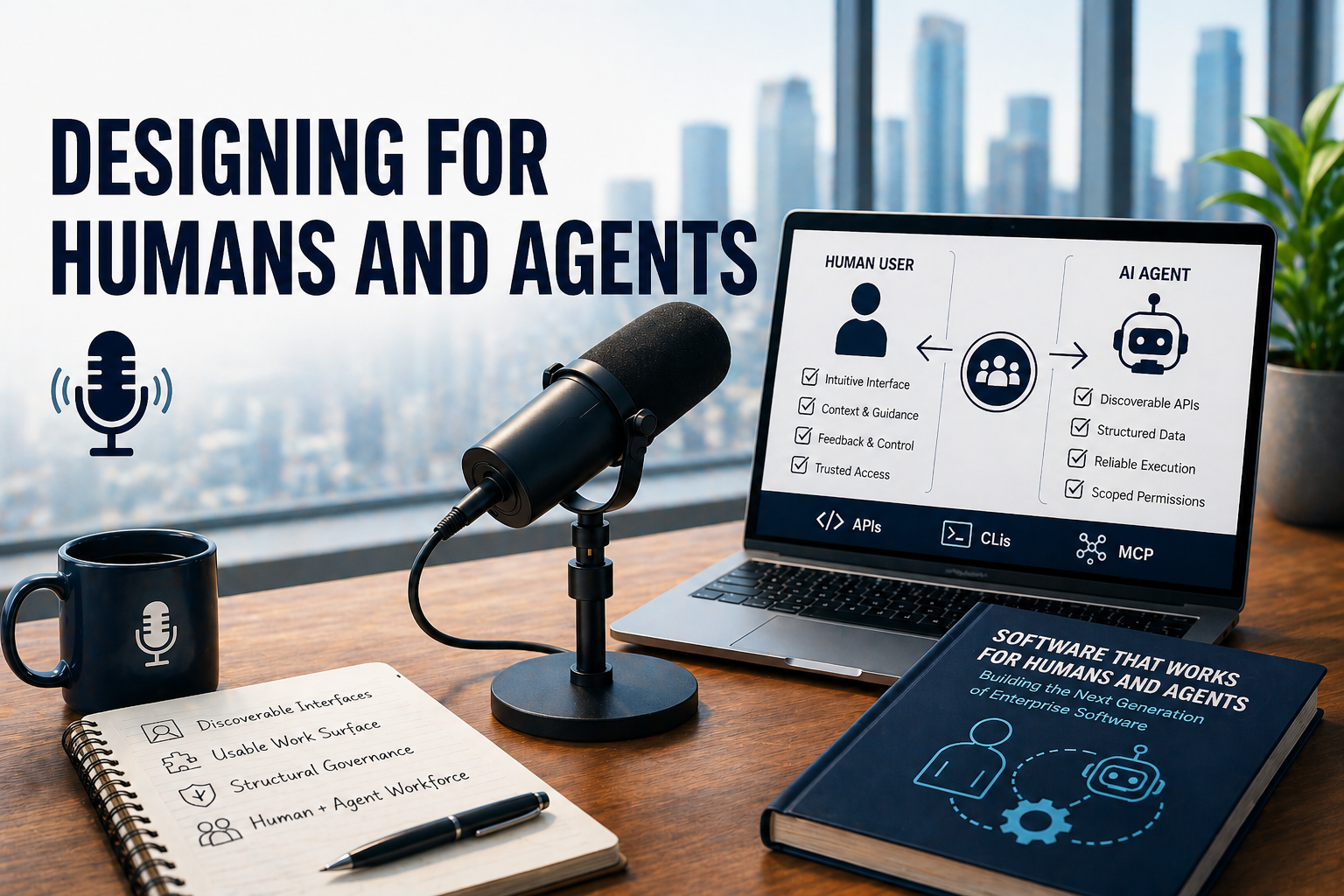 I had a chance to join Tom Smith again recently on the AI Agent & Copilot Podcast to talk about a topic I've been thinking about a lot lately. What happens to enterprise software when agents become real participants in the work?
The conversation grew out of a blog post I published earlier this month, Your Software Has New Users, where I made the argument that if businesses are heading toward a workforce that's part human and part agent, the software underneath the business needs to work for both kinds of users.
Tom and I covered a lot of ground in a short conversation. A few of the threads I thought were worth highlighting:
Agent-focused design is not optional, and it applies to everyone
Whether you're an ISV shipping a product or an internal team building tools for your own organization, the design requirement is the same. Your software needs structured, predictable interfaces that agents can discover, understand, and act through. What's different is how you get there. For an ISV, it shows up in the product roadmap. For an internal team, it shows up in architecture decisions.
APIs are necessary but not sufficient
Most enterprise software already has APIs, but most of those APIs were designed for system-to-system integration, not autonomous agent use. The gaps show up in discoverability, error handling, and completeness. Beyond APIs, there are CLIs for local and developer-centric environments, and MCP as the emerging common protocol layer for cloud-hosted agents. Mature software will eventually need all three pathways.
The "usable work surface"
One analogy I used that seemed to land: giving an employee access to a building is not the same as giving them a workspace they can actually operate in. Agents need the same thing from software. Not just an endpoint, but a surface that's discoverable, predictable, and safe to act through.
Governance has to be structural, not assumed
Human access control was built around people who exercise judgment at the boundary. Agents don't pause and ask whether they should do something just because they can. That means agent identity needs to be a first-class concept, permissions need to be scoped to task and context, and human review points need to be designed in from the start.
Most organizations are early on this curve
The honest assessment is that most vendors are still in the "add a Copilot to the UI" phase. A few platform-level investments are moving faster, but the broader agent-readiness question hasn't been fully addressed yet. The good news: this doesn't require starting over. It means expanding the design aperture of what you're already building.